

Workplace Cannabis Policies
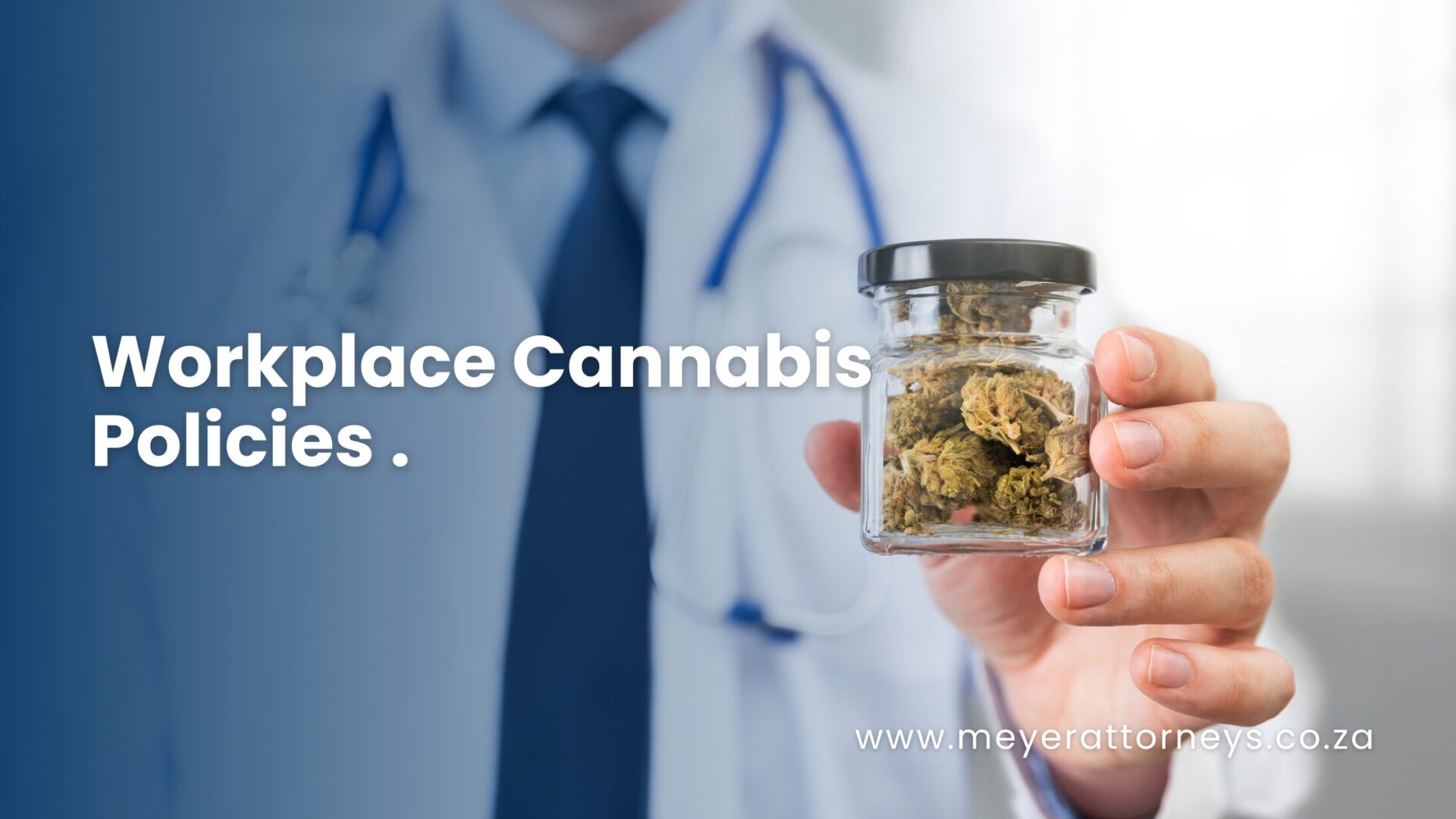
Workplace Cannabis Policies (South Africa)
Definition of “Workplace Cannabis Policies.” Workplace Cannabis Policies are employer rules that prevent impairment on duty, set fair and dignified testing procedures, and align discipline and accommodation with South African law. They respond to the Constitutional Court’s 2018 Prince judgment (which decriminalised private adult use) while still enforcing safety, productivity, and respect for employees’ privacy and dignity at work.
Long-tail phrases used where helpful for clarity and SEO: “South Africa cannabis at work policy”, “impairment vs presence testing THC”, “safety-sensitive roles and zero-tolerance”, “drug testing privacy and POPIA”, “religious and cultural accommodation cannabis”, “OHSA duty to maintain safe workplace”, “disciplinary code drafting for cannabis”, “case law trends on cannabis dismissal”.
Why Workplace Cannabis Policies matter after Prince (2018)
The Constitutional Court held that private adult use and cultivation in a private space is constitutionally protected. That does not create a licence to arrive at work impaired. Workplace Cannabis Policies draw a bright line: lawful private use at home versus fitness for duty on shift. They give managers clear tools to protect safety, comply with the OHSA duty to maintain safe workplace, and treat people fairly under the LRA and the Employment Equity Act.
Presence versus impairment: science that informs Workplace Cannabis Policies
Urine tests primarily detect metabolites and often prove past exposure, not current impairment. Saliva and breath show more recent use but still need context. A robust impairment vs presence testing THC approach combines (1) observable impairment indicators, (2) confirmatory testing with chain of custody, and (3) a fair chance for the employee to explain medications or off-duty use. That mix protects safety while avoiding knee-jerk discipline based only on a positive screen.
Testing, dignity and POPIA in Workplace Cannabis Policies
Testing is intrusive. Workplace Cannabis Policies must respect drug testing privacy and POPIA by giving transparent notices (why, what, how long you keep data), limiting who sees results, and securing records. Communicate that “consent” is not the only basis—testing should be necessary, proportionate, and tied to safety or operational needs. Use the least intrusive method that reliably achieves the purpose, and allow a second specimen for confirmatory testing at a lab.
Safety-sensitive roles and zero-tolerance in Workplace Cannabis Policies
In safety-critical environments (driving, operating heavy machinery, high-risk maintenance, mining and construction), it may be reasonable to require a “no impairment” standard and, in limited cases, a safety-sensitive roles and zero-tolerance rule. To defend it, do a written risk assessment, specify the safety-sensitive posts, and show why less restrictive controls won’t work. For non-critical roles, a nuanced standard focused on impairment (not mere presence) is generally sounder.
Religious and cultural accommodation within Workplace Cannabis Policies
South African law protects dignity, equality and religion. Religious and cultural accommodation cannabis means you assess requests case by case: consider the job’s safety profile, explore schedule adjustments, and weigh whether accommodation would create unjustifiable hardship or safety risk. Put reasons for granting or refusing accommodation in writing and provide an appeal path.
Disciplinary code drafting for Workplace Cannabis Policies
Your disciplinary code drafting for cannabis should distinguish: (1) refusal to test without good reason; (2) tampering with a sample; (3) testing positive plus credible evidence of on-duty impairment; (4) possession, dealing or use at work; (5) repeated breaches after counselling. Align sanctions with the LRA’s Code of Good Practice (progressive discipline) and document how the conduct hurt safety, trust or performance. Misconduct is not automatic merely because of a positive test for THC metabolites.
Remote work and home use: applying the policy
When people work from home, the workplace is wherever they are on duty. Workplace Cannabis Policies should say plainly: private, off-duty use is lawful; being impaired while working—whether on site or remote—is not. Provide a dignified self-report route for employees who suspect they are impaired and set out what happens next (e.g., re-allocation of duties or annual leave).
Union consultation, change management and training
Consult unions and workplace forums early to avoid grievances and to embed the policy in practice. Train supervisors on observation checklists and respectful interventions; train employees on testing procedures, rights, and support options. A South Africa cannabis at work policy that lives on the shop floor beats a perfect poster on a wall.
Data retention, breach response and transparency notices
Keep test results for no longer than necessary to manage the case and comply with statutory record-keeping. Lock down access, log viewing, and have a breach plan: notify the Information Regulator and affected employees if there’s a material compromise of health data. Drug testing privacy and POPIA are not tick-box exercises—explain how to make a request for access or correction.
Implementation roadmap for Workplace Cannabis Policies
-
Risk map: Identify safety-sensitive tasks and historic incident patterns.
-
Draft: Integrate testing, accommodation, and discipline with BCEA breaks and rest rules.
-
Consult: Union/employee input, especially on zero-tolerance proposals.
-
Pilot: Trial procedures and observation tools in one unit.
-
Train: Supervisors and employees; run simulations.
-
Launch: Provide pocket guides and forms.
-
Audit: Review case data, false positives, and grievances; refine annually.
FAQ — Workplace Cannabis Policies
1) Is zero-tolerance lawful in South Africa?
Sometimes. In genuinely safety-sensitive posts, a zero-impairment rule—and in narrow cases a zero-tolerance presence policy—may be justified if based on a documented risk assessment and consistent application. For non-critical roles, a focus on demonstrable impairment and performance is safer and more defensible.
2) Can we do random testing?
Yes, where there’s an operational need, a clear policy, and genuine randomness. Apply it neutrally (not only to certain departments or demographics), respect dignity, and send non-negative screens for confirmatory testing.
3) What’s the best test: urine, saliva or blood?
Each has trade-offs. Urine detects metabolites (longer window, poor proxy for impairment). Saliva has a shorter window (closer to recent use). Blood is intrusive and usually reserved for serious incidents. Choose the method that fits your risk profile and evidentiary needs.
4) Can we discipline for off-duty cannabis use discovered on social media?
Only if it creates on-duty impairment, brings the employer into disrepute, or conflicts with a genuine safety requirement. Private, off-duty use is constitutionally protected by Prince; policy must target conduct affecting work, not lawful private behaviour.
5) How do we accommodate religious or cultural use?
Consider the role’s safety profile, possibility of schedule adjustments, and alternatives like reassignment. Document reasons if you can’t accommodate and provide an appeal process to avoid unfair discrimination claims.
6) What are “observable indicators” of impairment?
Examples include slurred speech, poor coordination, unusual risk-taking, and strong odour—combined with witness notes and time stamps. Use a checklist before deciding to test. On its own, smell or “red eyes” is weak evidence.
7) How do we handle medical cannabis?
Treat it like any medication: request proof (script or recommendation), assess side effects, and adjust duties if needed. The fact of a lawful prescription does not licence safety-critical work while impaired.
8) What if an employee refuses to test?
Explain the basis, process and consequences; offer union or colleague representation. Unreasonable refusal can be misconduct—but give the employee a chance to state health or religious objections and consider alternatives.
9) Can results be shared with clients or other employers?
No, not without a lawful basis. Under POPIA, limit access strictly and never repurpose results beyond the specific employment case unless there is a clear legal requirement.
10) How long may we keep results?
Only as long as needed for the case and any legal processes (grievance, arbitration, litigation). Set retention periods in your POPIA notice and delete securely thereafter.
11) Are we required to offer rehabilitation?
It’s not always compulsory, but offering counselling or an EAP referral is often reasonable—especially where dependency is suspected and the role is not safety-critical. Record your efforts; they matter in fairness assessments.
12) What documentation wins dismissal cases?
A clear policy, risk assessment for the role, observation checklist, chain-of-custody records, confirmatory lab results, minutes of the hearing, and reasons showing why alternatives were inadequate. “Case law trends on cannabis dismissal” show that process and proportionality are decisive.
References
| Authority | Citation | Substance & Detailed Discussion | Importance |
|---|---|---|---|
| Constitutional Court: Minister of Justice and Constitutional Development & Others v Prince (and related matters) | 2018 ZACC 30 | Decriminalised private adult possession, use and cultivation in private. Confirms privacy autonomy but does not protect on-duty impairment or possession at work. | Sets the constitutional backdrop—private, off-duty use ≠ licence to work impaired. |
| Occupational Health and Safety Act (OHSA) | s 8 | General duty to provide and maintain a working environment that is safe and without risk to health, as far as reasonably practicable. Risk-based controls (training, observation checklists, testing) are justified for safety-sensitive roles. | Legal anchor for impairment management and zero-impairment standards in high-risk posts. |
| Labour Relations Act (LRA) | Schedule 8: Code of Good Practice — Dismissal | Requires substantive and procedural fairness. Sanctions must be proportionate; dismissal is typically reserved for serious or repeated misconduct with a fair process. | Governs how cannabis-related misconduct is investigated and sanctioned. |
| Basic Conditions of Employment Act (BCEA) | ss 14–15; 16–17 | Meal intervals (s 14) and daily rest (s 15) support safe scheduling during investigations or reassignments; Sunday/night work rules (ss 16–17) intersect with fatigue risk management. | Ensures safe rostering while testing or accommodating employees. |
| Protection of Personal Information Act (POPIA) | ss 18–19; 23–24; 71 | Transparency notices (s 18), security safeguards (s 19), access/correction rights, breach notifications, and caution around solely automated decisions affecting individuals. | Governs testing data, access rights, and limits on automated adverse actions. |
| Employment Equity Act (EEA) | s 6 | Prohibits unfair discrimination. Relevant to religious or cultural cannabis use and dependency-related issues; requires reasonable accommodation where appropriate unless unjustifiable hardship. | Frames accommodation duties and protects against discriminatory application of policy. |
| Code of Good Practice on the Prevention and Elimination of Harassment (contextual) | GN 1890 of 2022 | Guides respectful, dignified processes—useful for training managers to intervene without humiliation or stereotyping. | Supports humane, compliant investigations and conversations. |
Useful Links
For queries regarding the validity of employment contracts click here.
For information about employment rights in the entertainment industry click here.
For information about COIDA claims click here.
For general enforcement of employment rights click here.
For more information about rights in relation to remuneration click here.
For more information about rights during retrenchment click here.
For more information about the fairness of dismissals in absentia click here.
For more information about enforcing restraints of trade click here.
For more information about foreign nationals and working permits click here.
For more information about enforcing a CCMA award click here.
For more information about the right to parental leave click here.
For information about workplace bullying ad harassment click here.
For information about maternity leave click here.
For information about constructive dismissal click here.
For information about unfair labour practices related to training click here,
For queries about legal representation in disciplinary hearings click here.
If your query relates to how UIF is claimed click here.
If your query relates to a matter where the employee in question is a domestic worker click here
If your query relates to whether or not someone is an employee click here.
If you would like to know more about the retrenchment process click here.
If you would like to know more about employees rights during probation click here.
If you would like to know more about the registration of non-profit organisations click here.
If you would like to know more about protecting your creative works click here.
If you would like to know more about Non-disclosure agreements click here.
If you would like to know more about Non-circumventions provisions click here.
If you would like to know more about non-solicitation provisions click here.
This article is a general information sheet and should not be used or relied on as legal or other professional advice. No liability can be accepted for errors, omissions, loss, or damage arising from reliance upon any information herein. Don’t hesitate to contact Meyer and Partners Attorneys Incorporated if you require further information or specific and detailed advice. Errors and omissions excepted (E&OE).
